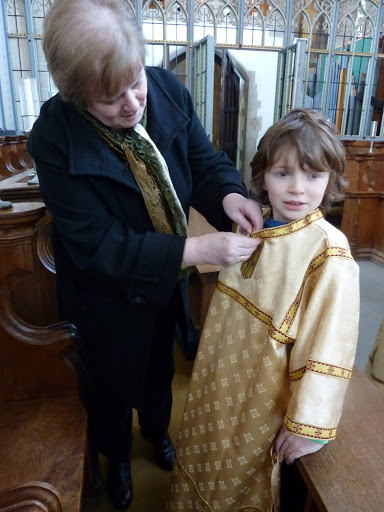
Hilary Miranda dresses Nicholas (Josh) in the new stichar she has made:
Nicholas with Reader Geoffry and Deacon Ian:

Nicholas and stichar “in action”, lighting candles and helping serve at the altar:

 Orthodox Parish of St Cuthbert
Hilary Miranda dresses Nicholas (Josh) in the new stichar she has made:
Nicholas with Reader Geoffry and Deacon Ian:
Nicholas and stichar “in action”, lighting candles and helping serve at the altar:

In honour of St Parasceva the New (read about her life here), whose feast day is this Sunday (October 14), matins will be replaced by the singing of an Akathist to the Saint.
St. Parascheva was born at the beginning of the 11th century A.D. into a wealthy, noble, and pious Christian family in the town of Epivat (now in Turkey) on the shores of the Marmara Sea. At the age of ten, while attending the liturgy in the “Church of the Holy Theotokos”, she heard the words, “Whosoever will come after Me, let him deny himself and take up his cross, and follow me” (Matt 16:24). The words of the Lord had a profound effect on the young girl, and they became the subject of her meditations.
The future St. Parascheva began to dress poor people in her expensive clothes but her parents objected, finding the girl’s charity more than they could understand or support, and trying to get her to stop. By the age of fifteen, after her parents had died, she entered a convent in the Jordan desert and there lived in strict asceticism. She returned to her homeland two years befor eher death, at the young age of twenty-seven. Miracles by her grave revealed her sanctity, and later her in-corrupt relics were moved to Bulgaria. In later centuries she was moved to Romania, back to Bulgaria, then on to Belgrade, and on to Constantinople, in order that the relics were kept safe from Ottoman invaders.
Finally, in 1641, the relics were secretly transferred from Constantinople, now under Turkish rule, all the way to Iasi (Jassy) in north-east Romania in recognition of help given to the Ecumencial Patriarch by Moldavian Prince Vasile Lupu. And St Parasceva’s in-corrupt relics remain in Iasi to this day, where hundreds of thousands of pilgrims travel each year to venerate them.
The travels of St Parasceva’s relics show how universally loved she is within the Orthodox world. As well as various cities in Romania, churches dedicated to her exist in Sofia (Bulgaria), Paloumba (Greece), Lviv (Ukraine), Belgrade (Serbia), Dubica (Bosnia), and Banovci (Croatia). It is only natural that a diverse parish like St Cuthbert’s would honour St Parasceva too.
Let us all piously praise all-honorable Paraskeva,
the intercessor for the afflicted.
She gave up her earthly life,
and received eternal incorruption.
Therefore, she has been granted the grace to work wonders
by the command of God.
+++
What is an Akathist?
An akathist is a hymn comprises 24 stanzas. The stanzas alternate between short, ending with the refrain Alleluia, and long. The first Akathist Hymn was written in honour of the Mother of God in the 6th century A.D by St Roman the Melodist. Later, a massive besieging army of Persians and Scythians were miraculously turned away from the walls of Constantinople. The relieved citizens believed their deliverance had come through the intercessions of the Mother of God, and so sang St Roman’s praises to her all night without sitting down – and so the hymn became known as the Akathist (Gr. meaning “without sitting”).
Since then, many other Akathists have been written, addressed to God, Jesus Christ, or a particular Saint: the words in each are different, but they all follow the same structure as the original Akathist Hymn.

The Calendar of Services for the next three months is now online. Please visit our calendar (or click on the small Orthodox icon on the left-hand side of this page).
We need to increase the congregational participation. In order to do that, we need you, dear members of our parish, to come on a regular basis to services, especially to the Holy Liturgy.

On Saturday 23rd June, at the Pisani chapel in Cromford, Derbyshire, there will be an Akathist of Thanksgiving.
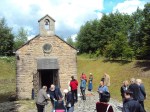
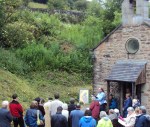
The Pisani Chapel is an Orthodox chapel built within the grounds of a stone-cutting business, Pisani Ltd., off the A6 near Cromford, Derbyshire. For address and contact details, see here.
The chapel is a converted barn, beautifully decorated with marble and stone sold by the company. A few pictures are shown below.
What is an Akathist?
An akathist is a hymn comprises 24 stanzas. The stanzas alternate between short, ending with the refrain Alleluia, and long. The first Akathist Hymn was written in honour of the Mother of God in the 6th century A.D by St Roman the Melodist. Later, a massive besieging army of Persians and Scythians were miraculously turned away from the walls of Constantinople. The relieved citizens believed their deliverance had come through the intercessions of the Mother of God, and so sang St Roman’s praises to her all night without sitting down – and so the hymn became known as the Akathist (Gr. meaning “without sitting”).
Since then, many other Akathists have been written, addressed to God, Jesus Christ, or a particular Saint: the words in each are different, but they all follow the same structure as the original Akathist Hymn.
The Akathist of Thanksgiving was composed by Metropolitan Tryphon (Turkestanov) +1934 – but frequently attributed to Father Gregory Petrov, who died in a Soviet prison camp. It is a song of praise from amidst the most terrible sufferings. With each day, some news of one thing or another arrives that is cause either for distress or anxiety – yet it is far better to meet such problems with prayer and thanksgiving. Everyone is welcome to join us in giving thanks to God!
The Pisani Chapel:



(NB: the translation we use may differ from this)
 Orthodox Parish of St Cuthbert